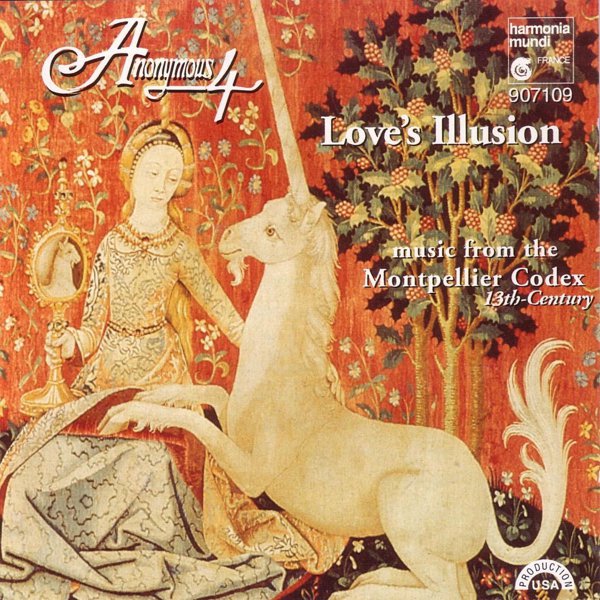
Love’s Illusion (Music From The Montpellier Codex 13th-Century) cover

Love’s Illusion (Music From The Montpellier Codex 13th-Century)

Released

The Montpellier Codex is the most famous collection of polyphony from the 13th century, and Anonymous 4’s is the most successful, satisfying contemporary animation of it. The short motet, “Ne sai que je die,” for instance, showcases the group’s athletic unison singing. It is one of many pieces from the Codex that become easily digestible in the hands of Anonymous 4. Those seeking complexity, though, will also find it here, as these pieces often pile melodies, texts, and meanings into single, compressed wholes.

Sean Wood

Suggestions
The Glory of Gabrieli cover

The Glory of Gabrieli

E. Power Biggs, Texas Boys' Choir, The Edward Tarr Brass Ensemble, The Gregg Smith Singers, Vittorio Negri
Lassus: Chansons cover

Lassus: Chansons

Dominique Visse, Ensemble Clément Janequin
Mahler: Symphony No.8 cover

Mahler: Symphony No.8

Arleen Auger, Chicago Symphony Orchestra, Heather Harper, Helen Watts, John Shirley-Quirk, Lucia Popp, Martti Talvela, René Kollo, Georg Solti, Vienna Boys' Choir, Vienna State Opera Chorus, Wiener Singverein, Yvonne Minton
Carthage cover

Carthage

The Crossing, Donald Nally
Choruses And Chorales From J.S.Bach: St Matthew Passion cover

Choruses And Chorales From J.S.Bach: St Matthew Passion

Monteverdi Choir, English Baroque Soloists, John Eliot Gardiner
Stravinsky: Symphony of Psalms cover

Stravinsky: Symphony of Psalms

Berlin Philharmonic Orchestra, Pierre Boulez
Palestrina: Missa pro defunctis; Motets cover

Palestrina: Missa pro defunctis; Motets

Chanticleer, Giovanni Pierluigi da Palestrina
French Chansons cover

French Chansons

Claudin De Sermisy, Clément Janequin, Josquin Des Prez, Roland De Lassus, Scholars of London, The Scholars